[Orthopedic Arthroscopy] Arthroscopic subscapularis suture
Release time: 15 Jul 2025 Author:Shrek
The subscapularis muscle is located in front of the scapula and is triangular in shape. Originating from the subscapular fossa, the muscle bundle passes upward through the front of the scapular joint and ends at the lesser tubercle of the humerus. Its function is to adduct, internally rotate and extend the scapular joint. The subscapularis tendon is relatively easy to miss. If the treatment is ignored, even if the supraspinatus and infraspinatus tears are well repaired, it will be difficult for the patient to fully recover the shoulder joint function.The subscapularis is the largest and most powerful muscle among the muscles involved in the rotator cuff. It occupies the vast majority of the subscapular fossa. Together with the supraspinatus, infraspinatus, and teres minor, it stabilizes the humeral head on the glenoid. It is also the only internal rotator muscle among the muscles related to the rotator cuff. It maintains the horizontal force couple balance of the shoulder joint during exercise and plays a dynamic stabilizing role in the shoulder joint.
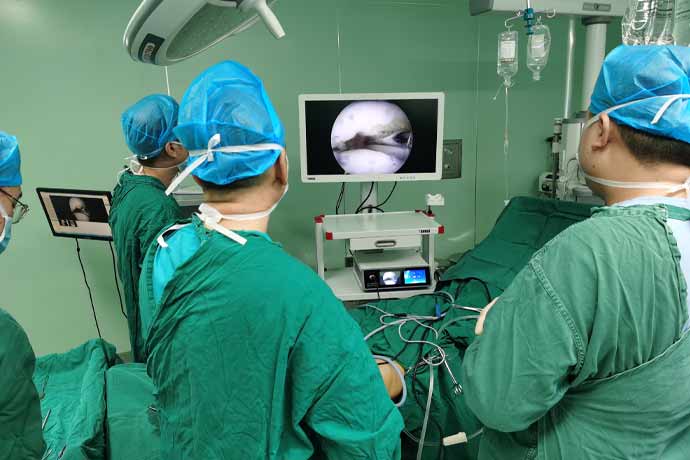
The subscapularis muscle is located in the subscapular fossa in front of the scapula and is covered by the serratus anterior muscle. It is a triangular flat muscle. It originates from the inner 2/3 of the subscapular fossa, the lower 2/3 of the front of the axillary edge of the scapula and the subscapular fascia. The muscle fibers gradually gather outwards and migrate through the tendon flatus through the front of the shoulder joint capsule, ending at the lesser tubercle of the humerus and the anterior wall of the joint capsule. The upper 2/3 part is the tendinous insertion point at the lesser tubercle, and the lower 1/3 part is the muscle insertion point at the humeral metaphysis.
Different arthroscopes have different observation fields. Compared with the 30° lens, the 70° lens can significantly improve the field of view of the subscapularis muscle and humeral tubercle, especially when observing the upper and medial structures of the subscapularis muscle more clearly.
Under different degrees of arthroscopy, different conditions of the subscapularis tendon are observed through the conventional posterior approach. Therefore, switching the viewing angle during surgery and using 30° and 70° mirrors alternately can ensure a comprehensive assessment of the integrity of the tendon.
In the conventional lateral decubitus position, because the humeral head has a natural posterior inclination, it is difficult for the arthroscope to cross the humeral head and observe the subscapularis tendon in front during the conventional posterior viewing approach. However, through the posterior lever technique (Posterior Lever Push), pushing the humeral head backward can create more space.
Applying a posterior force to the proximal humerus while applying a forward reaction force from the elbow moves the humeral head posteriorly, opening up the anterior space, which, combined with internal rotation, flexion, and abduction of the shoulder joint, can further expose hidden tendon tears.
Preoperative preparation
1. Imaging evaluation (X-ray, MRI):
The bone hyperplasia of the coracoid process and the nodule can be evaluated on the anteroposterior X-ray and the outlet position of the supraspinatus muscle, which can provide preoperative basis for coracoid process shaping and local polishing of the nodule during surgery. MRI can be used to evaluate subscapularis injuries and further guide the development of surgical plans.
2. Surgical procedure:
Posture placement, sterile draping, surgical incision marking, surgical approach establishment, arthroscopic exploration, microscopic cleaning, anchor placement, subscapularis suturing, knotting and fixation, etc.
3. Potential surgical complications and avoidance measures:
(1) Infection:
Strictly abide by the principle of asepsis, this operation requires the implantation of anchors, and prophylactic antibiotics are administered 30 minutes before the operation.
(2) Cerebral infarction:
The intraoperative blood pressure reduction is determined based on the patient's preoperative blood pressure, and the blood pressure reduction should not be too large. The incidence of cerebral infarction is lower in the lateral decubitus position than in the beach chair position.
(3) Brachial plexus traction injury:
Pay attention to controlling the weight and time of pulling.
(4) Neurovascular damage:
The establishment and operation of the surgical approach should be gentle and familiar with the relevant neurovascular anatomy.
Operating room preparation
1. Surgical instrument preparation: arthroscope, perfusion pump, standard arthroscopic instruments (suture hooks such as beak hooks, wire grabbers, knot pushers, and wire cutters), arthroscopic power system (planing blade, grinding blade), low-temperature plasma radiofrequency ablation system (plasma blade), and wired anchors.
2. Operating room equipment preparation: standard operating table, operating table, beach chair device (applicable to beach chair position), upper limb traction device (applicable to side-lying position), 3000ml saline, waterproof surgical drapes, and waterproof surgical gowns.
3. Posture management:
(1) Side lying position: with the affected shoulder on top, a postural pad underneath the body, and the angle between the back and the horizontal plane is about 30°. The upper arm abducts about 60°, flexes forward 10°, and the distal traction weight is 5kg~6kg.
(2) Beach chair position: The beach chair position frame is fixed on the operating table, the patient's trunk is in a 45° semi-supine position, the head is fixed on the head frame, and the inner edge of the affected scapula is at the edge of the operating table.
surgical technique
1. Clean the subscapularis tendon footprint area
2. Release the subscapularis tendon
3. Freshen subscapularis tendon
4. Place anchors
5. Suture the tendon
6. Knotting sutures
Postoperative management
Postoperative management of arthroscopic subscapularis repair requires the active participation of the patient. The formulation of the rehabilitation plan requires comprehensive consideration of tear size, tendon quality, patient age, fat infiltration and muscle atrophy, as well as whether the patient smokes, has diabetes, etc.; patients need to be educated before discharge, prescribe discharge analgesics, care for the wound, develop a follow-up plan, and perform postoperative imaging examinations to ensure the appropriate position of the implant.
1. Fix the brace immediately after surgery and provide appropriate cold therapy;
2. Move your elbow and wrist joints appropriately, 3 to 4 times a day;
3. The affected shoulder joint should be strictly immobilized within 2 weeks after the operation. After 2 weeks, the affected shoulder should be moved passively appropriately. The forward flexion and lift should be controlled within 90°. After 6 weeks, it can reach 90°~120°. External rotation should be controlled within 20°~30°;
4. Gradually increase the active range of motion of the shoulder joint 6 weeks after surgery, and further increase the passive range of motion;
5. Avoid moderate to heavy load exercise within 12 weeks, and gradually increase strength exercises for the affected shoulder after 12 weeks, and gradually increase the range of motion to the normal range;
6. Rehabilitation exercises related to work and sports can be carried out after 16 to 20 weeks;
7. Patients with huge rotator cuff injuries need to delay exercise and strictly immobilize the affected shoulder within 6 weeks after surgery.
- Recommended news
- 【General Surgery Laparoscopy】Cholecystectomy
- Surgery Steps of Hysteroscopy for Intrauterine Adhesion
- [Urology Cystoscopy Section] Cystoscopic Laser Lithotripsy
- [Laryngoscopy in Otolaryngology] Tonsillectomy
- [Otolaryngology Otoscopic Section] Excision of Cholesteatoma in the External Auditory Canal