[Thoracoscopic Surgery] Thoracoscopic Lung Reduction Surgery
Release time: 04 Nov 2025 Author:Shrek
Lung volume reduction surgery is a surgical procedure used to treat emphysema by surgically removing overinflated and damaged non-functional lung tissue. It is also known as lung resection or lung volume reduction surgery. Compared to traditional thoracic surgery, 4K thoracoscopic lung volume reduction surgery has advantages such as less trauma, less blood loss, faster recovery, and less pain. This procedure changes the situation of traditional thoracic surgery, which is characterized by large trauma and slow recovery. Patients with severe emphysema are often physically weak and have a low tolerance for surgical trauma.
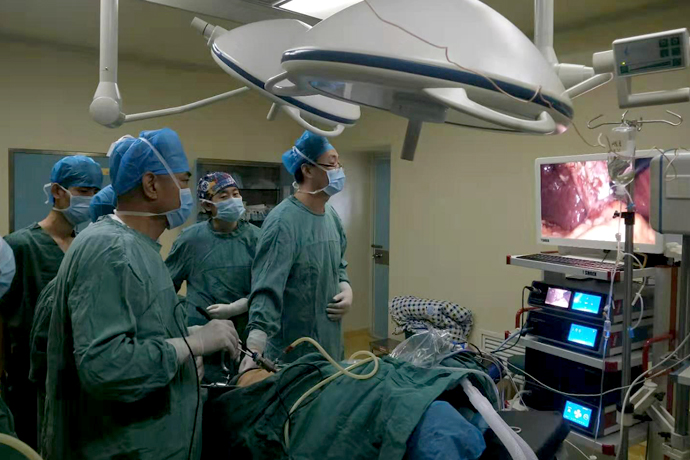
Compared to optimal medical treatment, lung volume reduction surgery (LVRS) can improve the quality of life and improve lung function, exercise tolerance, and long-term survival in some patients with surgical indications. Although LVRS can be performed via VATS or median thoracotomy, with similar complication rates, mortality rates, and outcomes, VATS offers faster recovery and lower costs.
Indications for LVRS include patients who remain symptomatic despite optimal medical treatment, including respiratory exercises, oxygen therapy, and pulmonary rehabilitation, which can help in patient screening and treatment. Patients with severe emphysema are generally in poor condition and require lower limb rehabilitation and dyspnea relief. Patients in better condition are better prepared to cooperate with postoperative activities, such as getting out of bed shortly after surgery and using spirometry to reduce respiratory complications. Patients who cannot cooperate well or whose pulmonary rehabilitation has failed are not suitable candidates for LVRS. The most important selection factor for LVRS is the presence of heterogeneous emphysema on CT and lung perfusion imaging.
Thoracoscopic Lung Volume Reduction Procedure
Surgical Steps
Most minimally invasive 4K ultra-high-definition thoracoscopic lung volume reduction is a staged bilateral procedure performed with the patient in a lateral decubitus position. Unless there is severe air leakage on one side postoperatively, the patient should be turned over to perform lung volume reduction on the other side. The resection area depends on preoperative CT and lung perfusion imaging, usually located in the upper lobe. This area often does not collapse during surgery due to poor elastic recoil.
Key Points
The surgery is performed from front to back at the top of the lung.
The resection begins in the anterior segment of the upper lobe, immediately adjacent to the upper margin of the right middle lobe or the lingular segment of the left lung.
Minor air leaks may take several weeks to heal. Manipulation and contact with the lung should be limited during the procedure. The lungs of patients with severe emphysema are very soft; even gentle perforation with a suture may cause a tear.
Reoperation to close the leak is rarely required.
Thoracoscopic Lung Volume Reduction Surgery
Step 1: Incisions
1. Incision 1: Make a 2cm incision at the 6th intercostal space along the midclavicular line, as low and close to the center as possible. This position is usually below the inframammary fold, one intercostal space. This incision allows the freed organ to bend posteriorly (away from the pericardium) so that instruments passing through this incision automatically point posteriorly towards the oblique fissure, not the heart. Insert a finger through the incision to check for adhesions.
2. Incision 2: Make a 5mm incision at the 9th intercostal space along the midclavicular line and insert a 5mm trocar and a 30° thoracoscope.
3. Incision 3: Make a 2cm incision at the 4th intercostal space along the midaxillary line.
Step 2: Decompression of the apical bulla
1. Exposure: Pull the right upper lobe of the lung towards the pleural apex.
2. With the thoracoscope pointing forward and the 30° lens pointing upward.
3. For bullae with poor collapse at the apex of the lung, use an electrocautery device to enter through incision 3 and cut into the right upper lobe tissue to decompress the bullae tissue in the upper lobe.
Step 3: Lung Resection
1. Exposure: Pull the lower lobe of the right lung directly towards the pleural dome.
2. The thoracoscope is pointed forward, and the 30° lens is pointed upward.
3. As with all surgeries, exposure is crucial. Use an oval forceps to lift the lung parenchyma through incision 3 and align it with the suture device inserted through incision 1.
4. The padding on the suture device helps reduce air leakage when stapled the lung. Do not apply force when placing the suture device, otherwise it may cause lung tearing and air leakage. Make sure to align the suture device with the lung tissue before placing it so that the suture device can easily close the lung tissue.
5. If the suture device is not accurately aligned with the lung tissue, it will be inserted obliquely into the lung, resulting in a lung tear.
Step 4: Surgical Completion
1. Exposure: Pull the lower lobe of the right lung directly towards the pleural dome.
2. Position the thoracoscope anteriorly, with the lens at a 30° angle to the apex.
3. Continue closing the lung with a padded stapler 3-4 cm from the sides of the horizontal and oblique fissures and close to the medial aspect of the hilum. After firing the stapler, move the oval forceps grasping the lung tissue close to the stapled lung tissue.
3. After staplering is complete, cut the padding portion connecting the specimen to the lung.
Step 5: Specimen Removal
1. Exposure: Since sufficient lung tissue has been removed during lung volume reduction surgery to provide good exposure of the thoracic cavity, there is no need to retract the lung tissue.
2. The thoracoscope is pointed anteriorly, with the 30° lens pointing apex.
3. The removed lung tissue is removed through incision 1 using oval forceps.
Postoperative Care
The endotracheal tube is removed in the operating room.
Pain management is urgently needed to allow the patient to get out of bed, cough, and use a spirometer. An epidural catheter is placed first, followed by anesthesia for analgesia. Patient-controlled analgesia (PCA) can be used if epidural analgesia is ineffective. Immediate postoperative pain management is crucial to prevent pneumonia.
Respiratory care is important.
Early movement in the corridor twice daily can reduce the incidence of pulmonary complications.
Active nebulization and pulmonary physiotherapy are essential. Negative pressure suction is unnecessary for chest drainage tubes.
If the chest drainage tube is low-positioned and leakage persists, a tube with a Heimlich valve can be used; this device facilitates patient ambulation.
Even if the patient did not have preoperative carbon dioxide retention, the partial pressure of carbon dioxide often reaches around 60 mmHg after lung volume reduction surgery.
Approximately 20% of patients experience cardiac arrhythmias, particularly atrial fibrillation, due to hypoxemia and atelectasis.
Gastrointestinal complications are common. If a patient has not had a bowel movement within 2 days, a mild laxative can be used. Swallowing air, painkillers, and epidural analgesia can all cause abdominal distension or even colonic perforation.
- Recommended news
- 【General Surgery Laparoscopy】Cholecystectomy
- Surgery Steps of Hysteroscopy for Intrauterine Adhesion
- [General Surgery Laparoscopy] 4K ultra-high definition laparoscopic deroofing and decompression of renal cysts
- [Ureteroscopy in Urology] Laser lithotripsy for ureteral stones
- [Laparoscopic Urology] Laparoscopic Radical Right Nephrectomy