[Urology Ureteroscopy] Application techniques and summary of "Eight Methods of Movement of the Scope" for intraluminal operation of rigid ureteroscope
Release time: 16 Sep 2025 Author:Shrek
Ureteroscopic lithotripsy is increasingly common in urology. The biggest wish of beginners is to master the operating skills of ureteroscopy in a short time, so as to reduce the occurrence of complications as much as possible. Rigid ureteroscopy technology plays a leading role in the diagnosis and treatment of middle and lower ureteral stones. It has the advantages of small trauma, fast recovery, accurate results and economy. As endourological surgical equipment and technology gradually become popular in China, more and more urological surgeons are learning and performing ureteroscopic lithotripsy surgery.
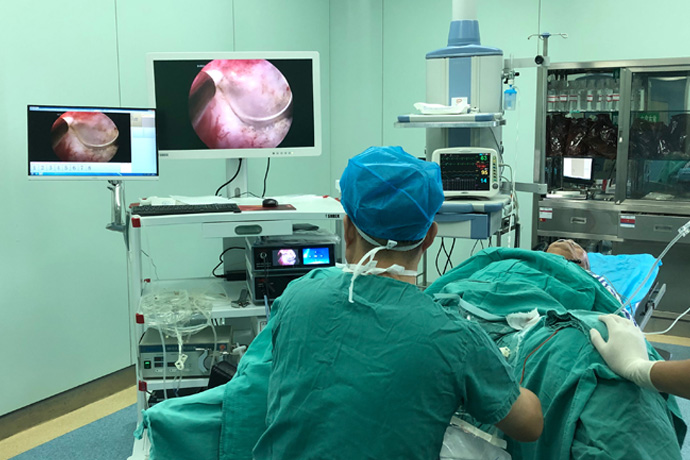
Safe and successful placement of the ureteroscope is the key to ureteroscopy technology. During the surgical operation, whether the ureteroscope can be successfully inserted and the stone site is reached is a prerequisite for successful intracavitary lithotripsy. We hereby summarize eight basic techniques for using rigid ureteroscopy and formulate strict operating procedures, which are simple and easy to learn. The eight techniques are "lifting the mirror, pressing the mirror, placing the mirror, picking the mirror, advancing the mirror, rotating the mirror, supporting the mirror, and withdrawing the mirror"). Summarize the up, down, left, right, front, back and rotation movements of the mirror body in the three-dimensional space, as well as the skills and precautions for various movements.
surgical method
1. Lift the mirror
For male patients, there is also a certain skill involved in passing the ureteroscope into the bladder through the urethra. The hard scope has just entered the urethra, and the long scope body has no support. If a beginner uses the hand holding the scope to search for the urethral cavity, the lens end will shake unstablely and with a large amplitude according to the lever principle. It often presses against the mucosa and cannot find the urethral cavity.
The correct technique is to keep the hand holding the mirror still, hold the penis with the middle finger and ring finger of the left hand on the left and right sides of the glans penis respectively, separate the outer opening of the penis with the thumb and index finger, and enter the urethra with the mirror in the right hand. Then, lift the penis toward the abdominal wall with your left hand (so that the urethral pubic antecurvature becomes straight and disappears). At this time, the mirror body is perpendicular to the ground, so it is called a mirror lift. Hold the penis straight and shake the penis to place the urethral cavity within the field of view of the lens. In other words, the urethral cavity is looking for the mirror instead of the mirror for the urethral cavity. Then, look directly into the mirror under the impact of water pressure. As long as the left hand is not relaxed and the direction is consistent with the mirror body, as the mirror drops nearly vertically, you will see the bulb. In the process, you will see a pubic antecurvature with the threshold of the urethra.
2. Pressure mirror
The tail end of the ureteroscope moves downward to become a compression scope, which is mainly used for the membranous urethra, prostate and lower ureter. After reaching the bulb, use the tip of the mirror as the center point, press down on the tail of the mirror, and you can see the membrane. At this time, you can increase the flushing water, or withdraw the mirror slightly so that the urethra is in the center of the screen. Slowly push forward while pressing down on the tail end of the mirror. Pay attention to the angle. The key is that there will be a "blind" moment in this process. Novices may not dare to enter the mirror when encountering this situation. At this time, increasing the water flow or withdrawing the mirror appropriately can reduce the "blind" process. The lower segment of the ureter, which is the aforementioned pelvic flexure, also requires continuous pressure during the endoscopy.
3. Mirror placement
The tail end of the ureteroscope moves laterally to form a swing mirror, which is divided into a swing mirror at the ureteral orifice and a swing mirror within the ureteral cavity. The ureteral orifice swing mirror is to swing the mirror toward the opposite side, because the opening of the lower ureter is usually inclined and has different shapes. By swinging the mirror, the bevel of the lens is aligned with the slope of the ureteral opening. After the ureteroscope enters the bladder, withdraw the tip of the scope to the bladder neck, raise the eyepiece, and slowly advance the scope to find the interureteral ridge. Then swing left and right along the interureteral ridge to find the ureteral opening and observe the situation around the opening. Then bring the front end of the ureteroscope close to and align it with the ureteral opening. The endoscopic ureteroscope is mainly used to pass through the ureteral curvature (renal flexure, terminal flexure, and vesical flexure).It should be noted that it is a taboo to develop the oscillating mirror into a different mirror. Forcibly changing the mirror will cause bending damage of the rigid ureteroscope, which is especially obvious in the renal flexure. Because the upper section of the ureter runs from outside to inside, the tail end of the ureteroscope in the upper section of the ureter is moved to the same side. At this time, it is most taboo to swing the scope violently to cause damage to the other side of the scope. The correct treatment method is to keep the head low and the feet high, and have the assistant under the ribs on the affected side. Apply pressure, hold up the waist of the affected side, insert a guide wire or use a syringe to slowly inject water into the ureteral cavity to straighten it.In short, you cannot look for the ureteral lumen with a mirror. Instead, you must use various methods to let the ureteral lumen look for the mirror's field of view. Otherwise, it is most likely to damage the lens body and cause irreversible bending damage. Operators, especially beginners, should pay special attention to the fact that the instinctive forceful removal of the scope may cause damage to the ureteroscope body, which may further lead to device complications such as seal damage and blurred vision.
4. Pick a scene
After aligning the ureteral opening with a swinging mirror, you can try to use the upper end of the scope to lift the ureteral opening, and use pressurized flushing to enter the ureteral opening. Generally, the success of picking up the mirror and inserting the mirror indicates that the ureteral opening is wider. If you need to use a guide wire to rotate the scope, it means that the ureteral opening is narrow. Please pay attention to the possibility of holding the mirror. The author commonly uses 6/7.5F semi-rigid ureteroscope. This is a thin scope and has a high success rate of mirror selection. Usually, if the mirror selection fails twice, the rotating mirror method is used. The 8/9.8F semi-rigid ureteroscope is more commonly used in clinical practice. It should be noted that the success rate of lens selection may be lower.
Some experts also call this compression of the endoscope. The author believes that the specific action is to advance the endoscope to the ureteral orifice, raise the tail end 30°~60°, push gently and continuously while slowly flattening the end end, and lift the upper lip of the ureteral orifice. The patient can often enter smoothly and there will be a "breakthrough feeling", so it is more accurate to call it "scope picking". Do not use too much force or violence when picking the lens, otherwise it may cause ureteral damage.
5. Into the mirror
The scope moves forward along the cavity to enter the scope. Because the urinary tract has a certain physiological curvature, it is often accompanied by the movement of pressing the scope, such as the posterior urethra and lower ureter, like climbing the scope. If you encounter resistance, you can gently rotate left and right to enter the mirror.
6. Mirror rotation
The mirror body rotates along the long axis to form a rotating mirror, which is divided into a large rotating mirror and a small rotating mirror. The large rotating mirror is used to enter the ureteral orifice. Because the ureteral orifice is small, it is difficult to lift the upper lip. The purpose of turning the scope is to use the guide wire to lift the upper lip (because the working channel is at the lower end of the scope body). After inserting the zebra guidewire, rotate the scope body 180° up and down, lift the guidewire with the scope body, lift the upper lip with the guidewire, and enter the scope along the guidewire. After passing through the ureteral wall segment, the rotating scope returns to its normal position.Always keep the guidewire within the field of view during the ascent, and the operation should be gentle to avoid damaging the ureteral wall. Small rotoscopes are used to treat ureteral curvatures. When the ureteroscope is advanced upward, the ureter is often tortuous. In most cases, the twisted ureter can be passed by rotating or moving the scope back and forth, adjusting the direction, etc. When the upper ureter is tortuous when entering the scope, try to turn the scope without swinging it, and combine it with other methods mentioned above to avoid damage to the scope body.
7. Hold the mirror
The mucous membrane holds the mirror to hold the mirror.
Small embrace of the mirror: When the mirror first moves in, the mucous membranes converge toward the center (like the spokes of a wheel), some are holding the mirror, and some are contracted by the ureter. If the mirror continues to move in, the mucosa sticks to the lens, and the field of vision is completely white. If it is caused by ureteral peristalsis, wait for the peristaltic wave of contraction to pass before entering the scope.
Big support of the mirror: The patient's body and abdomen are also shaking with the forward and backward movement of the mirror body. At this time, it is extremely dangerous and there is a possibility of ureteral avulsion.
8. Back out of the mirror
The mirror body moves backward along the cavity to withdraw the mirror.
Small withdrawal of the mirror: withdraw the mirror when the field of view is unclear, and then withdraw when the vision is unclear. Do not enter the mirror blindly to avoid perforation. Large retraction: Some ureteral tortuosity is artificial ureteral tortuosity caused by incomplete holding of the mirror. If the upper segment of the ureter is tortuous and cannot be passed through various methods, the ureteroscope can be directly withdrawn to the bladder. After waiting for a period of time, the ureteral opening will expand and the ureter will peristalsis and become straightened on its own. After the endoscope is used again, it may be possible to pass without special operations. When retracting the mirror, you need to rotate it to retract the mirror, and rotate it gently left and right to avoid holding the mirror.
For patients with large resistance when entering the scope or whose ureters are lead-tube-shaped, attention should be paid to withdrawing the scope from time to time to avoid discovering that the ureteroscope is tightly clamped when withdrawing the scope, and to avoid avulsion or breakage of the ureter and switching to open surgery. If you feel too much resistance when withdrawing the scope and it is difficult to pull it out, you can insert a catheter to drain the intrarenal fluid and reduce the intrarenal pressure. You can also provide adequate anesthesia and analgesia. On the basis of leaving a guide wire, withdraw the scope in a "zigzag" shape, and then withdraw from the scope after the resistance disappears.
Summarize
Among the eight techniques, the key to lifting and swinging the scope is to let the ureteral lumen find the field of view of the ureteroscope, rather than the ureteroscope looking for the lumen. This is extremely important when the ureter is tortuous in the upper ureter. Previous treatment methods include straightening the ureter by placing the head low and feet high, asking an assistant to apply pressure under the ribs on the affected side, lifting the waist of the affected side, inserting a guide wire, or using a syringe to slowly inject water into the ureteral cavity to fill it.The guide wire goes up and uses a hard body to straighten the ureter, and the scope is rotated to bring the lumen into the field of view. The common principle of these methods is to let the ureteral cavity find the field of view of the ureteroscope. Once you master this common principle, you can flexibly use the above measures, and "swinging the mirror without changing the mirror" greatly reduces the possibility of bending the ureteroscope for beginners. Holding the mirror is a specific observation indicator for stopping the mirror in case of ureteral avulsion and rupture injuries caused by holding the mirror. It is necessary to observe not only the performance under the mirror but also the performance outside the mirror.
In short, the causes of difficulties in rigid ureteroscopy are complex and diverse. When encountering difficulties, you should be calm and gentle, and avoid being rough and reckless. It is necessary to understand the patient's information in detail before surgery, make preliminary predictions about possible situations during surgery, and flexibly use various techniques to address difficulties caused by different reasons during surgery to improve the success rate of surgery.
- Recommended news
- 【General Surgery Laparoscopy】Cholecystectomy
- Surgery Steps of Hysteroscopy for Intrauterine Adhesion
- [Orthopedic UBE Section] Four Years of Evolution of UBE Technology: From Lumbar Fusion to the "Forbidden Zone" of Thoracic and Cervical Spine, and the Unignorable "Hydraulic Pressure Crisis"
- [Gynecological Hysteroscopy] Techniques for Preventing and Treating Complications of Hysteroscopic Surgery
- [Laryngoscopy in Otolaryngology] Tonsillectomy