[Otolaryngology Nasal Endoscopy] Methods and Precautions for Nasal Bleeding Control under Nasal Endoscopy
Release time: 13 Jan 2026 Author:Shrek
Epistaxis is a common clinical condition in otolaryngology and a symptom of many diseases, making its causes complex. As an otolaryngological emergency, the basic principle of treatment is to quickly locate the bleeding site and effectively stop the bleeding. Clinical treatment of epistaxis dates back over a thousand years, with traditional methods often involving nasal packing for hemostasis. This method is painful for patients, often ineffective, and can cause complications, especially in patients with hypertension and coronary heart disease. Treatment for common, intractable epistaxis typically involves anterior and posterior nasal embolization, arterial ligation, and embolization. Digital subtraction angiography (DSA) is a minimally invasive diagnostic and therapeutic technique with promising clinical applications, particularly for epistaxis caused by arterial malformations or aneurysms. After identifying the lesion site through angiography, embolization can effectively stop the bleeding. However, it is less effective for epistaxis caused by other factors. Compared to other methods, DSA is more complex to perform and carries greater risks, so the indications for DSA must be strictly adhered to.
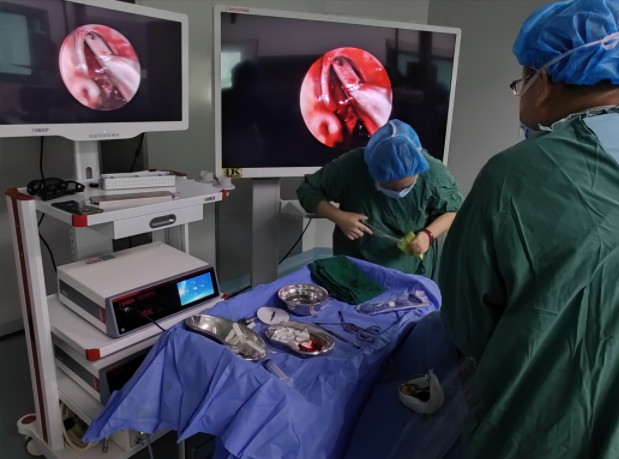
The widespread clinical application of nasal endoscopy has provided an advanced and accurate technical means for the examination, diagnosis, and treatment of epistaxis, significantly improving diagnostic and treatment levels. With the illumination, magnification, and observation capabilities of the nasal endoscope, the location and local condition of nasal bleeding can be accurately identified. Simultaneously, hemostasis can be achieved under direct vision using methods such as micro-packing, laser, microwave, and high-frequency electrocoagulation. When using nasal endoscopy to treat epistaxis, it is also essential to understand the location of the bleeding and its common causes. Mary (1991) reported on the application of nasal endoscopy in the examination and treatment of posterior nasal bleeding, comparing it with traditional methods. She pointed out that nasal endoscopy allows direct visualization and treatment of bleeding points in the posterior nasal cavity that are usually difficult to detect and diagnose, with a short operation time and good hemostatic effect. Wang Naya (1995) reported on the treatment of 56 cases of ordinary epistaxis using microwave under nasal endoscopy. The bleeding sites were arterial or capillary bleeding in the Kiesselbach's area of the nasal septum in 58.9% and posterior inferior meatus bleeding in 26.8%, with a success rate of 100%. Zheng Jun (1996) introduced 66 cases of nasal endoscopic high-frequency electrocoagulation hemostasis, all of which were cured, with posterior nasal bleeding accounting for 42.86%.
The methods for endoscopic nasal hemostasis are as follows:
(I) Location of nasal bleeding
The locations of nasal bleeding, in order of frequency, are:
1. Kiesselbach's area of the nasal septum
2. Wu's venous plexus in the posterior part of the inferior nasal meatus
3. The posteroinferior part of the nasal septum.
4. The anterior wall of the sphenoid sinus (posterior nasal aperture margin).
5. The roof of the nose (olfactory cleft).
6. Others. Besides the more common sites mentioned above, attention should also be paid to some more hidden or easily overlooked areas and signs. Local manifestations may include hemangioma-like bulges, often associated with recurrent bleeding, which require careful attention during examination.
(II) Indications and Methods of Endoscopic Nasal Hemostasis Endoscopic nasal hemostasis is suitable for arterial or venous bleeding in any part of the nasal cavity where the location can be clearly identified. Specific methods are described below:
1. Endoscopic Nasal Micropacking: Utilizing the advantages of nasal endoscopy—direct visualization, clear illumination, and accurate localization—after identifying the bleeding site, micropacking is performed using Vaseline gauze, hemostatic gauze, or hemostatic fibers. This method is highly efficient, maintains nasal ventilation, and significantly reduces patient discomfort, especially for bleeding in the posterior nasal cavity, avoiding unnecessary posterior nasal packing.
2. Endoscopic High-Frequency Electrocoagulation: After identifying the bleeding site, especially the stumps of small blood vessels, the electric arc formed between the high-frequency electrode and the tissue generates point-like high temperatures and carbonization at the bleeding site, sealing the vascular stumps and achieving hemostasis.
3. Laser-Assisted Endoscopic Nasal Hemostasis: Endoscopic laser carbonization and closure of nasal bleeding sites (blood vessels) are increasingly used in clinical practice. Clinically used laser devices include Nd:YAG lasers, CO2 lasers, KTP532 lasers, semiconductor lasers, and holmium lasers. Among these, Nd:YAG lasers and KTP532 lasers are most commonly used clinically.
4. Endoscopic Microwave Coagulation for Nasal Bleeding: Microwaves are high-frequency electromagnetic waves that can instantly raise tissue temperature, causing denaturation and coagulation to achieve hemostasis. The microwave probe can directly contact the bleeding site, resulting in rapid hemostasis.
4. Low-Temperature Plasma Radiofrequency Ablation for Hemostasis: The principle of this method is low-temperature coagulation. It utilizes the energy of low-temperature plasma radiofrequency at temperatures between 4 and 70°C to coagulate the bleeding point, achieving hemostasis. However, it is important to note that the coagulation time should not be too long; it can be stopped when the mucous membrane turns white or slightly yellow. When using this method for nasal septum bleeding, be wary of the complication of nasal septum perforation.
(III) Precautions for Endoscopic Treatment of Nasal Bleeding
Image 1. Use of Epinephrine Pads: In cases of severe bleeding, it is difficult to locate the bleeding site. Furthermore, electrocoagulation, laser, or microwave hemostasis cannot be performed during bleeding. Therefore, while ensuring adequate anesthesia, epinephrine pads can be used to contract and control active bleeding, and to clear accumulated blood in the nasal cavity. The bleeding site should be located based on the bleeding pattern and common bleeding sites. When there is no active bleeding after epinephrine application, the arterial bleeding site may only show a slight bulge of the mucosa; touching it with a suction device can induce bleeding, thereby confirming the bleeding site.
2. Selection of Appropriate Output Power: When using laser, microwave, or low-temperature plasma radiofrequency ablation, an appropriate output power should be selected. For example, the output power of Nd:YAG laser and KTP532 laser is approximately 30W, and the distance from the bleeding site should be 3-5mm; the microwave output power is approximately 40-60W. Coagulation should be performed in multiple sessions. Regardless of whether laser or microwave is used, attention should be paid to the risk of deep burns, especially when used for bleeding from the nasal septum, otherwise it may lead to nasal septum perforation.
(IV) Advantages of Using Nasal Endoscopy to Stop Nasal Bleeding
1. Easily identifies active bleeding points in various parts of the nasal cavity, especially those in the posterior nasal cavity.
2. Allows for precise operation under direct visualization, is simple and easy to perform, and provides accurate and rapid hemostasis with good results.
3. Minimal damage and pain, avoiding unnecessary packing of the anterior or posterior nasal cavity; therefore, this technique is particularly suitable for treating nasal bleeding in patients with hypertension, vascular diseases, and blood disorders.
- Recommended news
- 【General Surgery Laparoscopy】Cholecystectomy
- Surgery Steps of Hysteroscopy for Intrauterine Adhesion
- [General Surgery Laparoscopy] 4K ultra-high definition laparoscopic deroofing and decompression of renal cysts
- [Ureteroscopy in Urology] Laser lithotripsy for ureteral stones
- [Laparoscopic Urology] Laparoscopic Radical Right Nephrectomy