[Percutaneous Endoscopic Lumbar Discectomy] Percutaneous endoscopic lumbar discectomy for lumbar disc herniation
Release time: 30 Dec 2025 Author:Shrek
Have you noticed?
It turns out quite a few people have back problems.
Sitting for long periods causes back pain.
Standing for long periods causes back pain.
Office workers complain of back pain.
Students complain of back pain.
Sometimes even cleaning feels like your back is about to break.
Squatting down to lift something feels strenuous on your back.
Sometimes the pain is so bad that even painkillers don't help…
It's undeniable that
lumbar disc herniation is incredibly common nowadays.
It's not just the elderly;
young people are also falling victim to it.
This disease can cause severe back pain in mild cases,
and in severe cases, it can cause irreversible nerve damage.
According to statistics, the number of people with lumbar spine diseases in my country has exceeded 200 million.
Lumbar disc herniation currently accounts for 15.2% of the total population.
Its incidence rate is second only to the common cold.
In short, if we're not careful,
the next person to be affected by lumbar disc herniation could be you or me sitting here!
What is lumbar disc herniation?
First, let's talk about the intervertebral disc. The intervertebral disc is a structural organ connecting each vertebra, playing a crucial role in maintaining spinal stability, increasing spinal mobility, and cushioning against external shocks.
If you compare the intervertebral disc to a red bean bun, the filling is the nucleus pulposus inside, and the outer layer is the annulus fibrosus. When the lumbar intervertebral disc degenerates, external forces can cause the "outer layer" to rupture, allowing the "filling" to leak out. This can irritate or compress surrounding nerves, resulting in a range of clinical symptoms such as lower back pain, radiating pain and numbness in the lower limbs, bowel and bladder dysfunction, and abnormal sensation in the perianal and anal area. As the nerve compression persists and intensifies, it can lead to serious consequences such as incontinence and lower limb paralysis. This is what we commonly refer to as lumbar disc herniation.
Lumbar disc herniation is a relatively common disease. It is mainly caused by the degeneration of various parts of the lumbar intervertebral disc (nucleus pulposus, annulus fibrosus, and cartilaginous endplate), especially the nucleus pulposus. Under the action of external forces, the annulus fibrosus of the intervertebral disc ruptures, and the nucleus pulposus protrudes (or prolapses) from the rupture point into the posterior or spinal canal. This leads to stimulation or compression of adjacent spinal nerve roots, resulting in a series of clinical symptoms such as lower back pain, numbness and pain in one or both lower limbs.
Precautions
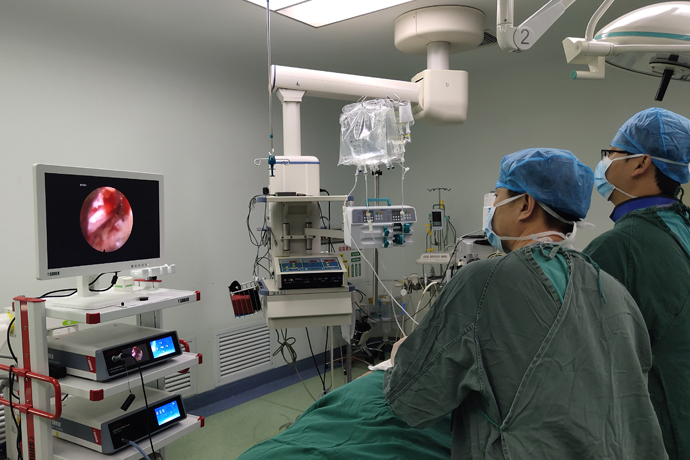
1. Conduct a preoperative visit to understand the patient's psychological and physical condition and provide health education.
2. Check that all necessary instruments and equipment are functioning properly before surgery.
3. Although the patient will receive local anesthesia, intravenous puncture is still required, and antibiotics should be administered before the surgery begins.
4. Because the patient will experience pain during the procedure under local anesthesia, it is important to reassure and communicate effectively with the patient.
5. The instruments used in the percutaneous endoscopic discectomy are quite delicate; handle them with care. Count the instruments before and after surgery, checking for completeness. Ensure the camera system cable is not bent and protect the lens.
6. Instruct the patient not to move during the procedure to avoid falls and contamination of the surgical field. Maintain aseptic technique when using the C-arm machine and use the C-arm cover correctly. Properly preserve the surgical specimen and secure it with the doctor after the surgery.
7. The camera cable and the radiofrequency ablation head cable must not be tangled; maintain a minimum distance of 30 cm between them, otherwise, it will interfere with imaging.
- Recommended news
- 【General Surgery Laparoscopy】Cholecystectomy
- Surgery Steps of Hysteroscopy for Intrauterine Adhesion
- [Urology Cystoscopy Section] Cystoscopic Laser Lithotripsy
- [Laryngoscopy in Otolaryngology] Tonsillectomy
- [Otolaryngology Otoscopic Section] Excision of Cholesteatoma in the External Auditory Canal