[Urology Laparoscopy] Laparoscopic adrenalectomy
Release time: 30 Sep 2025 Author:Shrek
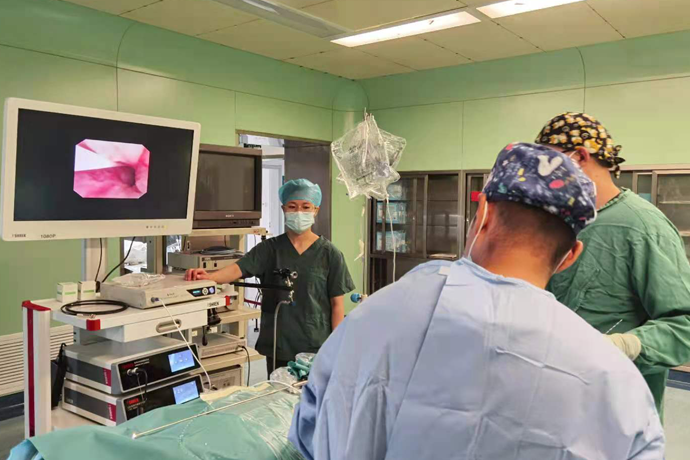
So far, the history of surgical treatment of adrenal glands has been more than a hundred years, and its surgical methods and routes have also undergone continuous development and improvement. In 1992, Ganger et al reported the world's first laparoscopic adrenalectomy (LA), which opened a new chapter in laparoscopic adrenal surgery. 4k laparoscopic adrenal surgery can significantly reduce intraoperative blood loss, reduce postoperative pain, and shorten hospitalization days. It has greater advantages than open surgery. Laparoscopic adrenalectomy has become the standard surgical procedure for most benign adrenal tumors. In recent years, the development and application of robot-assisted laparoscopy technology in urology surgery has become a general trend.As early as 1999, some scholars performed the first robot-assisted laparoscopic adrenalectomy (RA), and then gradually developed into an important alternative to traditional laparoscopic adrenalectomy. However, the current limited evidence-based medical evidence shows that compared with traditional laparoscopic adrenalectomy, there is no significant difference in perioperative complications, mortality, blood loss, conversion rate, etc. between robot-assisted laparoscopic adrenalectomy, but the cost of robotic surgery is relatively high. Therefore, laparoscopic adrenal surgery will remain one of the important procedures in adrenal surgery.
Indications for surgery
Patients with adrenal tumors should consider various factors such as tumor endocrine function, tumor size, tumor nature, and the patient's general condition to determine their surgical approach. Laparoscopic surgery may be considered for benign adrenal tumors less than 6 cm in diameter and some malignant adrenal tumors that are smaller in size. Open surgery is currently the standard surgery for adrenocortical cancer. If the tumor is small and has no invasion of surrounding organs, laparoscopic surgery can also be selected.Most pheochromocytoma can be treated laparoscopically. However, in order to avoid local recurrence or seeding due to tumor rupture during surgery, open surgery is recommended for pheochromocytoma or paraganglioma with a diameter >6 cm or that is invasive. If the surgeon has mature laparoscopic skills, laparoscopic surgery can also be selected for pheochromocytoma or paraganglioma that is >6 cm and has no obvious invasion of surrounding organs.For bilateral benign familial pheochromocytoma with MEN2 syndrome, VHL syndrome, NF-1 syndrome, etc., adrenalectomy with partial adrenal tissue preservation should be recommended on the premise of ensuring complete tumor resection. If primary aldosteronism caused by unilateral adrenal hyperplasia or aldosteronoma is diagnosed, unilateral adrenal surgery should be selected. However, there is no unified conclusion in the academic community on the specific resection method (total adrenalectomy or adrenalectomy with partial adrenal tissue preservation).For Cushing's syndrome with clear unilateral hyperplasia or adrenal adenoma, it is recommended to consider preserving part of the adrenal tissue on the affected side. For non-functioning adrenal lesions, some normal adrenal tissue should be preserved if the potential for malignancy is not considered.
Surgical approach selection
Adrenal gland (tumor) resection can be done either through the retroperitoneal or transperitoneal approach. Currently, there are different options and advantages for Trocar puncture methods and locations. Here, only one of the methods is selected and introduced.
1. Retroperitoneal approach: The patient lies completely on the healthy side, and takes the folding knife position or raises the lumbar bridge; make a transverse incision on the iliac crest of the mid-axillary line, incise the skin and subcutaneous fat in sequence, bluntly separate the muscle layer and lumbar dorsal fascia with a vascular forceps, separate the retroperitoneum with fingers, and push the peritoneum ventrally; the expansion balloon is placed into the retroperitoneal cavity, inflated with 600-800 mL, and maintained in the inflated state for 3-5 minutes Then exhaust and pull it out; make two more instrument holes under the costal margin of the anterior axillary line and the twelfth costal margin of the posterior axillary line, and insert 12mm and 5mm Trocars respectively (select and adjust according to the surgeon's habits); insert a 12mm Trocar into the original incision as a lens hole, and after insertion, you can choose to partially suture the incision to avoid air leakage.
2. Transabdominal approach: The patient is in a completely healthy lateral decubitus position, or in a 60-70° lateral decubitus position, and takes the jackknife position or raises the lumbar bridge. Use a pneumoperitoneum needle or a small incision at the level of the umbilicus next to the rectus abdominis to establish a pneumoperitoneum. After placing a 12 mm Trocar, insert 12 mm (left lateral decubitus) or 5 mm (right lateral decubitus) Trocar, and a 5 mm (left lateral decubitus) or 12 mm (right lateral decubitus) Trocar is placed near the level of the umbilicus in the anterior axillary line according to the surgeon's habit; in the left lateral decubitus position, a 5 mm Trocar can be placed under the xiphoid process to lift and pull the liver during surgery; each Trocar should be distributed in a triangle as much as possible, and a sufficient distance should be maintained.
Surgical methods and procedures
Insert trocar:
There are many different options for trocar placement, focusing on the three-point puncture method. The first point (camera observation channel) is at the lateral edge of the right rectus abdominis and at the level of the umbilicus; the second and third points (operating channels) are respectively located above the right anterior axillary line and at the level of the umbilicus, at the lateral edge of the right rectus abdominis and 2cm below the costal margin. After the Veress needle is inserted through the first point to establish pneumoperitoneum, a 10~12mm cannula is inserted from the first point, a laparoscopic camera is inserted, and after exploring for damage to organs and intestines, the second and third points are punctured under direct vision guidance.The second and third trocars are used for the operating channel. The dominant hand operating channel uses 10~12mm casing; the non-dominant hand operating channel uses 5mm casing. For right adrenal surgery, a fourth trocar can also be inserted to insert straight grasping forceps to push the liver apart. The fourth point can be set at the mid-axillary line and 2cm below the costal margin, and can be adjusted appropriately according to the patient's body shape, tumor size and location.
Expose the adrenal glands and central adrenal vein:
Insert trocar:
There are many different options for trocar placement, focusing on the three-point puncture method. The first point (camera observation channel) is at the lateral edge of the right rectus abdominis and at the level of the umbilicus; the second and third points (operating channels) are respectively located above the right anterior axillary line and at the level of the umbilicus, at the lateral edge of the right rectus abdominis and 2cm below the costal margin. After the Veress needle is inserted through the first point to establish pneumoperitoneum, a 10~12mm cannula is inserted from the first point, a laparoscopic camera is inserted, and after exploring for damage to organs and intestines, the second and third points are punctured under direct vision guidance. The second and third trocars are used for the operating channel. The dominant hand operating channel uses 10~12mm casing; the non-dominant hand operating channel uses 5mm casing.For right adrenal surgery, a fourth trocar can also be inserted to insert straight grasping forceps to push the liver apart. The fourth point can be set at the mid-axillary line and 2cm below the costal margin, and can be adjusted appropriately according to the patient's body shape, tumor size and location.
Expose the adrenal glands and central adrenal vein:
First, the lateral peritoneum is incised along the paraascending colic groove, and the ascending colon is freed inward to expose the perinephric fascia on the surface of the right kidney; then, the triangular ligament of the liver is incised, and with the help of an assistant, the right lobe of the liver is pushed upward, so that the entire right lobe of the liver is turned upward to expose the liver surface; Then, the descending part of the duodenum is pushed inward to expose the inferior vena cava; finally, the perinephric fascia and fat sac are opened to expose the right renal hilum, and the central adrenal vein can be seen by moving upward along the inferior vena cava, and from there, the golden adrenal gland can be found in the fat sac of the upper pole of the kidney.
Removal of the adrenal glands (total adrenalectomy):
The inferior vena cava end and the adrenal end of the central adrenal vein are clamped and severed with Hem-o-lok, and the medial edge of the adrenal gland is freed. After freeing the medial edge, the perinephric fat covering the surface of the adrenal gland is lifted, and the perinephric fascia and fat between the adrenal gland and the upper pole of the right kidney are incised. The lateral edge of the adrenal gland is basically avascular, and the entire adrenal gland can be removed after dissociation.
Removal of the tumor (partial adrenalectomy):
If the adrenal tumor is located in the medial branch, lateral branch of the adrenal gland, or the apex of the adrenal gland, partial resection of the adenoma and adrenal gland can be performed. After finding the tumor, use an ultrasonic scalpel to separate the upper and lower edges of the tumor and the front and rear surfaces of the tumor. The adrenal gland tissue connected to the tumor can be cut off with an ultrasonic scalpel or titanium clamps can be used to clip and cut it.
To remove the adrenal gland or tumor:
Carefully explore the surgical field, completely stop bleeding, and place a drainage tube on the wound. Place the removed adrenal gland or tumor into a specimen bag and remove it. The surgical incision is closed layer by layer and the operation is completed.
left adrenal surgery
Insert trocar:
Left adrenal gland surgery generally uses a three-point puncture method. The first point (observation channel) is at the lateral edge of the left rectus abdominis and the level of the level of the umbilicus. The second and third points are respectively located above the left anterior axillary line, at the level of the level of the umbilicus, and 2cm below the lateral edge of the left rectus abdominis and the costal margin. After first inserting the Veress needle through the first point to establish pneumoperitoneum, insert a 10~12mm trocar from the first point and insert the laparoscopic camera. After exploring whether there is organ damage in the abdominal cavity, the second and third points of puncture are performed under direct vision guidance. A 10~12mm trocar is placed in the main operating hole; a 5mm trocar is placed in the secondary operating hole. According to intraoperative needs, a fourth puncture point can be made at the posterior axillary line and 2cm below the costal margin, and a 5mm trocar can be inserted to push the kidney or spleen away to expose the location of the adrenal gland.
Expose the adrenal glands and central adrenal vein:
First, the lateral peritoneum is incised along the lateral parasulcus of the descending colon, and the descending colon is freed medially; then, the peritoneum lateral and above the spleen is continued to be incised upward, and gravity is used to turn the spleen and pancreatic tail medially, exposing the perirenal surface of the anterior medial surface of the upper pole of the left kidney. fascia (Figure 1); then, cut through the renal fascia and fat sac on the inner side of the upper pole of the kidney (Figure 2), and find the golden left adrenal gland; finally, expose the left renal pedicle downward, find the left renal vein, and find the central adrenal vein along the upper part of the renal vein.
To remove the adrenal gland:
The central adrenal vein was freed between the lower edge of the left adrenal gland and the left renal vein (Figure 4), and its renal vein and adrenal gland ends were clamped with Hem-o-lok and then cut. Starting from the upper edge of the adrenal gland, the small branches from the inferior phrenic artery are treated with ultrasonic scalpel or titanium clips; the medial edge is also freed to deal with the small branches from the aorta. There may be some other small blood vessels from the left renal artery and vein at the lower edge of the left adrenal gland, which can be treated with ultrasonic scalpel to reduce bleeding. Finally, the lateral edge is freed and the entire adrenal gland is removed.
The conventional procedure for organ removal is to cut off the arteries first and then the veins. Reasonable design of surgical steps is that the operation of the previous step pave the way or prepare for the next step or the next few steps. The process of layering is also a process of severing the adrenal artery and exposing the central vein. What finally appears is the ridge where the center of the adrenal gland is located.
- Recommended news
- 【General Surgery Laparoscopy】Cholecystectomy
- Surgery Steps of Hysteroscopy for Intrauterine Adhesion
- [Orthopedic UBE Section] Four Years of Evolution of UBE Technology: From Lumbar Fusion to the "Forbidden Zone" of Thoracic and Cervical Spine, and the Unignorable "Hydraulic Pressure Crisis"
- [Gynecological Hysteroscopy] Techniques for Preventing and Treating Complications of Hysteroscopic Surgery
- [Laryngoscopy in Otolaryngology] Tonsillectomy