[Otolaryngology Otoscopy] Treatment of foreign bodies in the external auditory canal
Release time: 13 Aug 2025 Author:Shrek
In the long queue outside the ear, nose and throat clinic of the hospital, there are always some people who come because of foreign bodies in the external auditory canal.
doctor, doctor,
The bugs are in my ears.
Will it creep into your brain?
doctor, doctor,
Lego toys are put in the ears,
Will I get otitis media?
doctor, doctor,
The button battery was put in the ear.
Does it matter?
There are many types of foreign bodies in the external auditory canal. In summary, they can be divided into animal (such as insects, leeches, etc.), plant (such as beans, grains, wheat grains, etc.) and non-biological (such as small toys, iron filings, stones, gauze, etc.) categories. It is more common in children because they like to put small objects in their ears. It can also occur in adults. It is often caused by breaking a match or wooden stick into the ear when digging the ear; it can also occur due to trauma or foreign matter invading during work. If you are not careful when treating external auditory canal or middle ear diseases, gauze, cotton, etc. can be left in the external auditory canal. Insects caused by sleeping outdoors or doing farm work in the summer, or cerumen plugs in the ears.
Non-irritating foreign matter
Small and non-irritating foreign bodies can remain for a long time without any symptoms; larger foreign bodies can cause earache, tinnitus, hearing loss, reflex cough, etc.
Live insects and other animal foreign bodies
It can crawl and commotion in the external auditory canal, causing severe earache and tinnitus.
vegetable foreign body
After swelling with water, it can cause vegetative inflammation and irritate or compress the external auditory canal, causing swelling and pain.
Button battery
When a button battery becomes embedded in the ear canal, the humid environment of the ear canal can cause electrolyte leakage and cause severe alkaline burns. This chemical corrosion will quickly destroy the ear canal skin, tympanic membrane, and even middle ear structures, causing tissue liquefaction and necrosis or even damage to the cochlea and nerves, leading to deafness. At the same time, battery discharge will quickly burn tissue cells, causing obvious swelling and pain at the impaction site.
Foreign bodies can remain in the external auditory canal for a long time, compressing surrounding tissues, and may cause secondary infection, eventually leading to local tissue inflammation, necrosis, etc. Some foreign bodies can be surrounded by cerumen to form cerumen embolism.
Symptoms of foreign body invasion
1. Painful and harmless: Some small non-biological foreign bodies may not cause much trouble.
2. Large and close: The bigger the foreign body is and the closer it is to the tympanic membrane, the more obvious the symptoms it will cause.
3. Sharp and hard: may damage the external auditory canal or tympanic membrane, causing earache and hearing loss.
4. Motile insects: Their activities in the ear canal can cause severe discomfort.
Endoscopic ear treatment
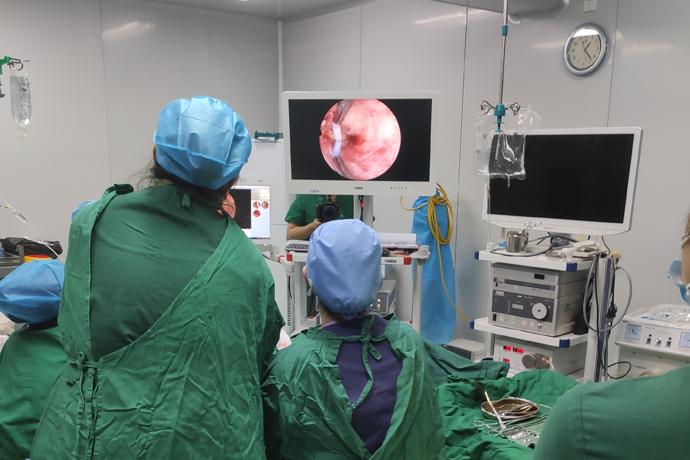
Removing foreign bodies under traditional headlight vision often requires multiple attempts, resulting in damage to the external auditory canal, foreign bodies moving deeper, pain and patient refusal to cooperate, etc., increasing the difficulty of removal. The diagnosis and treatment of foreign bodies in the external auditory canal under otoscopy has obvious advantages over traditional methods. Not only can the type and shape of the foreign body be clearly identified, but the adjacent relationship between the foreign body and the external auditory canal and tympanic membrane can also be observed, the degree of damage to the external auditory canal and tympanic membrane can be assessed, the movement of the foreign body can be observed in real time and the use of the instrument can be adjusted, and the foreign body can be removed in one go.
Removing different foreign bodies in the external auditory canal under otoendoscopy requires different methods and techniques:
1. When the foreign substance is soft or has a grippable part (such as cotton), you can directly use tweezers or alligator pliers to grasp it firmly and remove it.
2. Foreign objects in holes can be removed with a crochet hook. If necessary, the foreign objects can be moved. After adjusting the angle, hook the crochet hook into the hole and remove it.
3. If the foreign body in the external auditory canal is a live insect, liquid paraffin or tetracaine solution can be dripped first to immobilize, paralyze or kill the insect, and then remove it with a straw, tweezers or alligator forceps.
4. Do not use tweezers for round hard foreign objects to prevent the foreign object from slipping and pushing deep, or even damaging the tympanic membrane. You can use a cerumen hook or other hook-shaped instrument to hook out the foreign object through the gap between the foreign object and the external auditory canal, over and around the back of the foreign object.
5. The button battery can be removed using a magnetic device (such as a magnetic telescopic rod).
Things to note
If a foreign body is found in the ear canal, you can try to point the affected ear downward and pull the auricle to see if the foreign body can be poured out. If an animal foreign body such as an insect enters, you can fill the ear canal with cooking oil, wait for a few minutes, let it suffocate and then see if it can be poured out.
Remember not to blindly pick out your ears to avoid pushing foreign objects deeper into the ear canal and damaging the tympanic membrane. If the foreign objects cannot be removed by taking the above measures, you should immediately seek treatment at the otolaryngology department of the hospital.
For patients who are able to cooperate, most foreign bodies can be removed under outpatient otoscopy; for children who are unable to cooperate or where the foreign bodies are deep and tightly impacted, removal under intravenous anesthesia is highly efficient and safe.
- Recommended news
- 【General Surgery Laparoscopy】Cholecystectomy
- Surgery Steps of Hysteroscopy for Intrauterine Adhesion
- [Orthopedic UBE Section] Four Years of Evolution of UBE Technology: From Lumbar Fusion to the "Forbidden Zone" of Thoracic and Cervical Spine, and the Unignorable "Hydraulic Pressure Crisis"
- [Gynecological Hysteroscopy] Techniques for Preventing and Treating Complications of Hysteroscopic Surgery
- [Laryngoscopy in Otolaryngology] Tonsillectomy