【Otorhinolaryngology Rhinoscopy】Treatment of turbinate hypertrophy under rhinoscopy
Release time: 30 Jul 2025 Author:Shrek
Chronic rhinitis is relatively common clinically. This disease is difficult to cure and is prone to recurrence. Long-term swelling of the nasal mucosa can cause turbinate hypertrophy, nasal congestion, loss of smell, headache, dizziness and other symptoms.
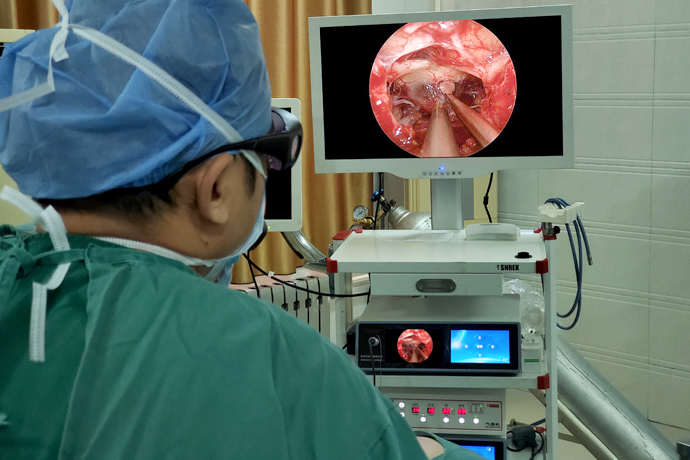
The turbinates are an important structure on the lateral wall of the nasal cavity. The lateral wall of the nasal cavity has three bony turbinates that protrude into the nasal cavity and are arranged in a trapezoidal shape. They are called superior turbinate, middle turbinate, and inferior turbinate. The bones are covered with nasal mucosa.
The common narrow space between the free edge of each turbinate and the nasal septum is called the common nasal passage, which is the passage for respiratory gas to enter and exit the lower respiratory tract through the nasal cavity.
The nasal mucosa is rich in mucus glands, serous glands and other glands, which can produce a large amount of secretions, which can moisten the nasal cavity, absorb dust, kill bacteria and viruses, and protect the body.
The nasal mucosa also contains abundant spongy tissue composed of venous blood vessels. A spongy sinusoid is formed between the inferior turbinate mucosa, capillaries and venules, and contains abundant blood-containing cavities.
The cavernous sinusoids contract under normal circumstances and expand when stimulated by cold air, thereby regulating the temperature of the inhaled air, which is part of the human body's self-protection.
[Analysis] The main symptoms of turbinate hypertrophy:
1. Local vasoconstriction: Mucosal contraction is not obvious after local application of vasoconstrictors.
2. The nasal congestion is severe. The enlarged nasal cavity squeezes the inside of our nasal cavity and makes us feel severe symptoms of nasal congestion. The symptoms are mostly persistent, often mouth breathing, and the sense of smell is often reduced.
3. Increased nasal discharge, which is thick and mostly mucus or mucopurulent. Postnasal drip can irritate our throats and cause coughing and phlegm.
4. The inferior turbinate is obviously enlarged to the naked eye, or the inferior turbinate and middle turbinate are enlarged at the same time, causing the inside of our nasal cavity to be blocked.
5. The mucosa is swollen, pink or purple in color, uneven in surface, or knotted or mulberry-shaped, with the front end of the inferior turbinate and its free edge being the most obvious.
6. Inflammation: When the enlarged middle turbinate compresses the nasal septum, it can cause compression or inflammation of the preethmoidal nerve branched off from the ophthalmic branch of the trigeminal nerve, resulting in irregular forehead pain that radiates to the bridge of the nose and orbit, which is called preethmoidal neuralgia.
The main dangers of turbinate hypertrophy include:
01. Influence hearing loss
Swelling or hypertrophy of the turbinates often causes nasal congestion, which in turn affects Eustachian tube ventilation and drainage, leading to ear symptoms such as tinnitus and hearing loss. When the turbinate is enlarged, it will press against the nasal septum, which may cause the trigeminal nerve, preethmoidal nerve or other inflammatory diseases, resulting in irregular episodes of frontal pain.
02. The long-term effects of inferior turbinate hypertrophy will cause disfigurement.
With long-term nose obstruction, the child has been accustomed to breathing through the mouth, and the teeth and hard palate have developed narrow and high. The jaw and face are also underdeveloped, the bridge of the nose is uneven, the sides of the nose gradually shrink, the lips become sausage-shaped, the nasolabial folds gradually become shallower, and the facial appearance also changes.
03. Loss of mucosal epithelial cilia
Swelling of the submucosal layer causes tissue proliferation and increases the thickness of the nasal membrane. Over time, it will lead to changes in nasal polyps, hyperplasia of periosteum and bone tissue, and hypertrophy of turbinate bones. Patients must discover their condition in time. To prevent the disease from becoming more serious.
04. Leading to severe nasal congestion, breathing difficulties, and loss of sense of smell.
The nasal mucus is thick and mostly mucus or mucopurulent. Symptoms such as headache, dizziness, memory loss, etc., when affecting the physiological functions of the nasal cavity, blood oxygen concentration will decrease, affecting the function of body tissue and metabolism, and may even lead to serious complications such as asthma, emphysema, and cor pulmonale.
05. Preethmoidal nerve compressing the trigeminal nerve
When the enlarged middle turbinate compresses the nasal septum, it can cause compression or inflammation of the preethmoidal nerve branched off from the ophthalmic branch of the trigeminal nerve, resulting in irregular episodes of forehead pain that radiate to the bridge of the nose and orbit, which is called preethmoidal neuralgia, also known as preethmoidal nerve syndrome.
Treatment of turbinate hypertrophy:
Turbinate hypertrophy is a common disease among ear, nose and throat diseases. It usually develops from chronic simple rhinitis. The cilia of the mucosal epithelium fall off and become stratified cubic epithelium. The submucosal layer is edema and then undergoes fibrous tissue hyperplasia, resulting in mucosal hypertrophy. Over time, it can become mulberry-like or polyp-like, and the periosteum and turbinate bone can also become hypertrophic. Low-temperature low-ion ablation performed under the endoscopic camera system eliminates the disadvantages of traditional surgical treatment, such as poor therapeutic effect, painful treatment process, and easy recurrence. It achieves no recurrence after surgery and no pain during surgery. It is also the preferred treatment method for the treatment of allergic rhinitis, chronic rhinitis, snoring, pharyngitis, etc.
1. For patients under local anesthesia, 1% lidocaine should be used for submucosal infiltration of the inferior turbinate. The amount of lidocaine on each side of the inferior turbinate is 4 to 5 ml. The submucosal injection is performed from the front end of the inferior turbinate. As the amount of anesthetic injected increases, the anesthetic drug gradually infiltrates under the mucosa from front to back to the back end of the inferior turbinate. If the inferior turbinate on the affected side is only hypertrophic at the middle and posterior ends, anesthetic drugs can be injected starting from the middle of the inferior turbinate. If the patient is under general anesthesia, saline can be injected into the inferior turbinate on the surgical side instead of lidocaine, or no drug can be injected into the inferior turbinate.
2. Punch ablation: The No. 4845 plasma radiofrequency knife is used to penetrate from the front end of the inferior turbinate on the operation side to the submucosal membrane. Under the action of 5 levels of energy from front to back, the submucosal hole is drilled and ablated to ablate the thick submucosal tissue of the inferior turbinate until the back end. The total depth of the cutter is mostly between the first and second black lines marked on the plasma cutter head. The second black line is approximately equivalent to the back end of the inferior turbinate. Then retreat from back to front to the front of the inferior turbinate. When removing the knife, use the 4th block to briefly coagulate and then exit, or you can do without the coagulation block. The entire action time of the ablation channel is generally within 10 seconds, and the residence time in a certain part is no more than 5 seconds to avoid side damage to the mucosa caused by too long action time. During the operation, the rapid shrinkage of the inferior turbinate tissue can be seen in most patients, showing the immediate effect of plasma radiofrequency.
3. Packing: In most cases, there is no bleeding during the operation, only a small amount of bleeding at the entry point. Sterile gauze can be used to pack the front of the nasal cavity to compress and stop bleeding, and it will be removed after 15 minutes; if there is no bleeding, no packing is required.
If you are already a patient with turbinate hypertrophy or nasal inflammation, it is recommended that you go to the hospital in time. Only by clearly understanding the symptoms of turbinate hypertrophy can you detect the disease at the first time and provide timely and effective treatment. Turbinate hypertrophy has many symptoms and is very harmful. It is crucial to treat turbinate hypertrophy in a timely and effective manner.
- Recommended news
- 【General Surgery Laparoscopy】Cholecystectomy
- Surgery Steps of Hysteroscopy for Intrauterine Adhesion
- [Orthopedic UBE Section] Four Years of Evolution of UBE Technology: From Lumbar Fusion to the "Forbidden Zone" of Thoracic and Cervical Spine, and the Unignorable "Hydraulic Pressure Crisis"
- [Gynecological Hysteroscopy] Techniques for Preventing and Treating Complications of Hysteroscopic Surgery
- [Laryngoscopy in Otolaryngology] Tonsillectomy